Implantable defibrillator (ICD)
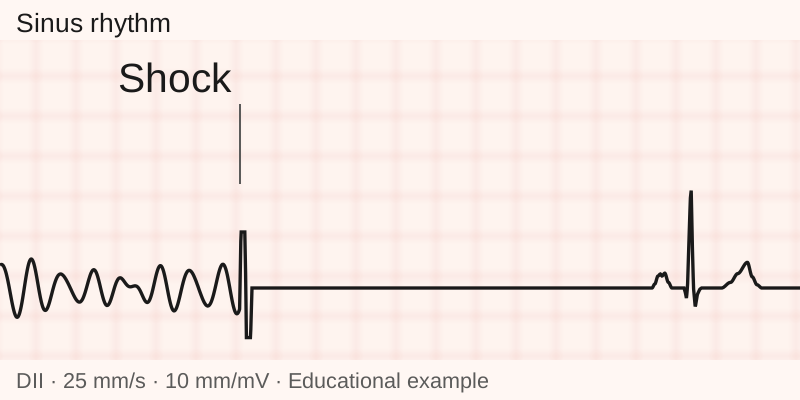
Ventricular fibrillation, shock and sinus rhythm. Educational example; it does not represent an individual patient's outcome.
An implantable cardioverter-defibrillator (ICD), also called an implantable defibrillator, monitors the heart rhythm and can treat potentially fatal ventricular arrhythmias. Whether it is indicated depends on the cause of the arrhythmia and each person's risk.
Detect and treat
There is no required sequence of ATP followed by a shock.
Evaluation, implantation and follow-up
-
At the evaluation
The team investigates the cause of the arrhythmia, reversible factors and the expected benefit. Your needs guide the choice of system.
-
During implantation
The position of the generator and the path of the lead depend on the type of ICD. The system is tested and programmed.
-
At follow-up
Carry your device card and follow your plan for any shocks. Follow-up visits review records, battery and programming.
What an ICD is and which rhythms it treats
An ICD monitors the heart rhythm. When it detects a ventricular arrhythmia that meets the programmed criteria, it can record the episode and deliver a therapy.
That therapy may be antitachycardia pacing (ATP), cardioversion or defibrillation by shock. ATP does not always come before a shock, and not every ICD offers ATP or pacemaker pacing. In selected people, the device can reduce the risk of sudden death, but it does not cure heart disease or replace medication, ablation when indicated, or regular follow-up.[1]
Because it is implantable, an ICD is different from the external defibrillator used in ambulances and hospitals. It is also called an ICD, implantable cardiac defibrillator or cardioverter-defibrillator. The term “defibrillator pacemaker” can cause confusion: some transvenous ICDs pace slow heartbeats, but other systems do not have this function.
Who is evaluated for an ICD implant
Implantation may be considered when there is a significant risk of ventricular tachycardia or ventricular fibrillation, arrhythmias that can cause cardiac arrest. Some people with a heart attack scar, heart failure, cardiomyopathies or inherited electrical diseases may have this risk.[1][2]
A Holter monitor, electrocardiogram or isolated number does not determine the indication. The evaluation seeks to clarify the cause and risk of the arrhythmia, identify reversible factors, and discuss the expected benefit and limits of an ICD for each person.[1][2]
In heart failure, the assessment considers ejection fraction, symptoms and the risk that remains despite recommended treatment. After a recent heart attack or revascularization, the reassessment period indicated for the case must be respected. The team weighs other conditions, functional capacity and expected benefit. Specific cardiomyopathies and inherited electrical diseases have their own criteria.[1][11]
Primary and secondary prevention
In secondary prevention, an ICD is discussed after a cardiac arrest caused by a ventricular arrhythmia or high-risk sustained ventricular tachycardia. First, it is necessary to investigate whether the episode had a completely reversible cause.
For primary prevention the aim is to protect the person before an event when the underlying disease indicates increased risk. The decision considers whether treatment is appropriate and whether the expected benefit is consistent with the clinical condition and prognosis.[1][2]
These terms describe when prevention occurs; they do not make implantation automatic. The decision is made with the person, the specialist team and, when appropriate, family members.
How an ICD detects and treats an arrhythmia
Depending on the rhythm identified, the device and its programming, therapies may include:[1][3]
- Antitachycardia pacing (ATP): rapid pulses that can stop some ventricular tachycardias without a shock. Not every system offers ATP, and it is not suitable for all rhythms.
- Shock: the ICD can deliver synchronized cardioversion or defibrillation to stop the arrhythmia.
- Pacing for slow heartbeats: available in some transvenous ICDs.
Episodes recorded by the ICD are reviewed at follow-up visits. This helps investigate appropriate or inappropriate therapies and guide programming adjustments.[1]
Transvenous and subcutaneous ICDs: what is the difference?
In a transvenous ICD, the generator is usually placed under the skin in the upper chest. One or more leads reach the heart through a vein. Depending on the system, it may offer ATP and pacing for slow rhythms in addition to shocks.
In a subcutaneous ICD (S-ICD), the generator and lead sit under the skin, with no lead inside the veins or heart chambers. It avoids complications specific to an intravascular lead, but does not provide permanent pacing for bradycardia, ATP or cardiac resynchronization. It can provide only temporary pacing after a shock.[1][3]
The table summarizes these differences based on clinical references.[1][3]
| Transvenous ICD | Subcutaneous ICD (S-ICD) | |
|---|---|---|
| Where the components are placed | Generator under the skin of the chest; one or more leads reach the heart through a vein. | Generator and lead under the skin, with no lead inside the veins or heart chambers. |
| Possible therapies | Can deliver a shock and, depending on the system, ATP and pacing for slow rhythms. | Delivers shocks; does not provide ATP, permanent pacing for bradycardia or cardiac resynchronization. |
| Venous access and limitations | Venous access and intravascular leads are part of the assessment of risks and future needs. | Avoids complications specific to an intravascular lead, but can provide only temporary pacing after a shock. |
A standalone subcutaneous ICD, called an S-ICD, may be considered when a person needs defibrillation and does not need permanent pacing for slow heartbeats, resynchronization or antitachycardia pacing, called ATP. The team also assesses whether the system can adequately detect the rhythm and the importance of preserving venous access. The indication and availability of each system need to be confirmed with the service.[3][13]
How to prepare for implantation
Before implantation, the indication, alternatives, benefits and limitations are discussed to inform consent. The review of tests and medications includes anticoagulants, antiplatelet drugs and diabetes medications.
Instructions on fasting, anesthesia, hospital admission and discharge are set for the planned procedure. Signs of infection or another condition that increases risk may lead to postponement of the implant.
Do not stop or change medications on your own. Bring an up-to-date list of medications, allergies, test results and information about any devices already implanted.
How an ICD is implanted
For a transvenous ICD, the generator occupies a space created under the skin. With imaging guidance, the lead passes through a vein to the heart. The lead is connected to the generator, and the system is tested before the incision is closed.
For an S-ICD, the generator is usually placed on the side of the chest. The lead passes under the skin near the breastbone without entering the blood vessels or the heart.
Anesthesia, testing, procedure duration and hospital stay are determined during preoperative planning according to the clinical situation and chosen system.[1]
Expected benefits, risks and limitations
An ICD can stop potentially fatal ventricular arrhythmias and reduce the risk of sudden death in appropriately selected people. The cause of that risk, general health, life expectancy and clinical condition help determine whether implantation may be beneficial.[1][2]
Not everyone with an ICD receives therapy from the device. When therapy is delivered, it may be ATP or a shock, and inappropriate therapies can also occur. Because the device does not treat the cause of heart disease, medications, ablation when indicated and follow-up remain part of treatment.[1]
ICD risks and limitations
Risks vary with the system and clinical situation and should be discussed during consent. They include:[1]
- bleeding, hematoma, pain or infection in the generator area;
- vascular injury, thrombosis, pneumothorax (air around the lung) or hemothorax (blood around the lung) with transvenous access;
- lead displacement, fracture or failure; rarely, cardiac perforation and fluid around the heart;
- arrhythmia during the procedure;
- a painful appropriate shock or inappropriate therapy;
- a future need for reprogramming, generator replacement or system revision;
- anxiety, fear of shocks and emotional impact.
An S-ICD avoids a lead inside the veins, but it can still cause infection, discomfort, detection failure or an inappropriate shock.[1][3]
Recovery and care after implantation
Discharge and return to activities depend on recovery, the type of ICD and the underlying arrhythmia. Follow the time frames provided by your team. It should give you these instructions in writing, including wound care, bathing, arm movements, physical effort, work and exercise.[1][5]
Fever, increasing pain, spreading redness, warmth, swelling, discharge or opening of the wound require assessment the same day. Contact the team; if you cannot obtain care, go to an emergency department. Do not handle the generator area.[9][1][5]
The team advises on driving after assessing the reason for implantation, fainting or ICD therapies and applicable rules. After a shock, do not drive to seek care; ask for help with transport. Obtain individual advice before driving again.[5]
Having an ICD does not automatically rule out magnetic resonance imaging (MRI). The team assesses the complete system, including the generator and leads, and the conditions of the scan. Some systems without conditional labeling may also be scanned in selected situations at centers with an appropriate protocol and team. Appropriate assessment, programming and monitoring are required. Before scheduling, say that you have an ICD and consult the team that follows your device.[1]
Keep a phone, watch or accessory with a magnet at least 15 cm from the ICD. Do not place them in a pocket over the device. Carry your device card and tell healthcare professionals about the device before tests and procedures. Follow the manufacturer's and your team's specific instructions.[12]
What to do after a shock and when to seek urgent care
After any ICD shock, the episode needs to be assessed even if you feel well. If there was a single shock and you feel well, contact the clinic during business hours or go to the emergency department at HCor or Hospital Sírio-Libanês. Outside clinic hours, go to one of those emergency departments. Also follow your individual plan. If there is more than one shock, or if you experience fainting, chest pain, shortness of breath or feel unwell after a shock, call SAMU 192 or immediately go to the nearest emergency department. Do not drive to seek care; ask for help with transport. WhatsApp is for scheduling, not emergencies.[7][8]
The accompanying person should follow the emergency service's instructions. WhatsApp is for scheduling and should not be used for urgent situations.
Fear, sadness or anxiety after a shock deserve attention. Talk to the team; psychological support and education about the device may be part of care.[5]
ICD follow-up and programming
Follow-up visits assess the battery, leads, healing and recorded episodes, including delivered therapies. The results may guide programming adjustments, medication review and discussion of symptoms and quality of life.[1]
When available and organized by the service, remote follow-up transmits ICD information and may reduce some in-person device checks. The team decides which visits remain necessary. Sending data does not guarantee an immediate response and does not replace emergency care.[10]
The battery usually lasts for years. Generator replacement is planned when checks show that the battery is approaching the end of its life; the leads are assessed separately.[1]
Alternatives to an ICD and related devices
There is no single alternative to an ICD that suits everyone. Depending on the cause and risk, treatment may prioritize medication, correction of reversible factors, revascularization or catheter ablation. The assessment may also conclude that the device's benefit is not proportionate.
Devices have different functions:[1][2]
| Device | Main function |
|---|---|
| Conventional pacemaker | Mainly treats slow rhythms and blocks; it does not defibrillate. |
| CRT-P | Provides resynchronization and does not defibrillate. |
| ICD | Detects and treats certain dangerous ventricular arrhythmias; pacing functions vary. |
| CRT-D | Provides resynchronization and also offers defibrillator therapies. |
The choice depends on the function of each device. The arrhythmia, condition of the heart and person's priorities are also considered. In cases of heart failure with an electrical conduction abnormality, the page about cardiac resynchronization device implantation (CRT) explains the role of resynchronization.
Frequently asked questions
Is an ICD the same as a pacemaker?
Does an ICD always deliver a shock?
Does ATP always come before a shock?
What is the difference between an ICD and CRT-D?
Does an abnormal Holter result mean I need an ICD?
Can someone with an ICD have an MRI scan?
Can I drive after implantation or a shock?
Clinical sources
-
Diretriz Brasileira de Dispositivos Cardíacos Eletrônicos Implantáveis, 2023
Arq Bras Cardiol. 2023;120(1):e20220892. DOI: 10.36660/abc.20220892. Definitions, selection, implantation, programming, risks and magnetic resonance imaging.
-
2022 AHA/ACC/HFSA Guideline for the Management of Heart Failure
ICD selection for primary prevention in the context of heart failure and decisions based on expected benefit.
-
Periprocedural Management and Multidisciplinary Care Pathways for Patients With Cardiac Implantable Electronic Devices
AHA Scientific Statement. Circulation. 2024;150:e183-e196. DOI: 10.1161/CIR.0000000000001264. Pacing limitations of subcutaneous and extravascular systems.
-
2021 ESC Guidelines on cardiac pacing and cardiac resynchronization therapy
MRI conditional status of the complete system and the need for a protocol.
-
Living With Your Implantable Cardioverter Defibrillator
Patient education, living with the device and emotional health.
-
2025 Adult Basic Life Support
Recognition of an unresponsive person with absent or abnormal breathing, calling emergency services, compressions and use of an AED.
-
Implantable Cardioverter Defibrillator (ICD): Shock Plan
Plan for contacting the service after an ICD shock and recognizing situations requiring urgent care.
-
SAMU 192
Public guidance on calling SAMU 192 in emergencies.
-
Pacemakers: After Getting a Pacemaker
Guidance after device implantation, signs of infection and immediate contact with the team for fever.
-
HRS/EHRA/APHRS/LAHRS consensus on remote device monitoring, 2023
Organization of remote follow-up and its limits in the presence of urgent symptoms.
-
2026 ESC heart failure guideline
Assessment of ICD risk and expected benefit in heart failure.
-
FDA. Magnets in phones and watches may interfere with implanted devices
Guidance to keep devices with magnets at least 15 cm from the device.
-
Knops et al. Original study of a modular S-ICD and pacing system, 2024
Distinguishes the standalone S-ICD from modular systems with other capabilities.
The references support general education and do not replace individual assessment.
ICD evaluation
A specialist evaluation can help you understand whether an ICD is indicated, answer questions about the proposed device or discuss treatment after a ventricular arrhythmia. Bring hospital reports, electrocardiograms, Holter recordings, imaging tests and your medication list.
Request an evaluationScheduling WhatsApp: +55 11 92137-6068. This channel does not handle emergencies. In an emergency, go to an emergency department or call SAMU 192.[8]