
Cardiac resynchronization device (CRT)
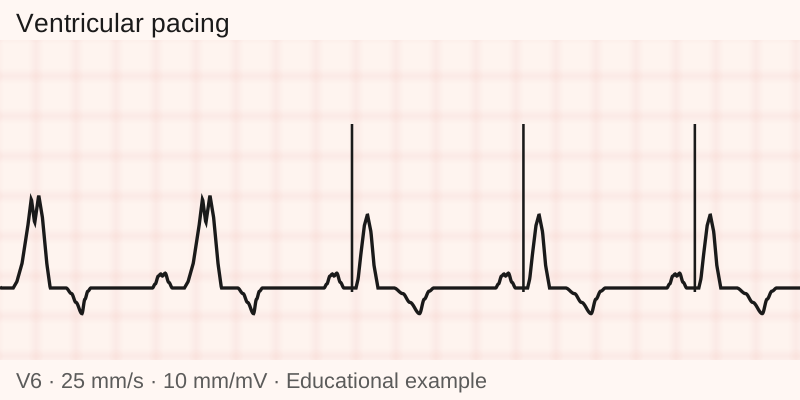
Wide QRS in V6 and ventricular pacing. Educational example; it does not represent an individual patient's outcome.
Cardiac resynchronization therapy (CRT) uses an implantable device to help the ventricles contract in a more coordinated way. It may be indicated for some people with heart failure and complements treatment with medication.
Coordinate
Goal: more coordinated activation.
Evaluation, implantation and follow-up
-
At the evaluation
The team reviews your tests and medication list to discuss the indication and expected benefit.
-
At implantation
The team chooses the system, implants and tests the leads, and programs pacing according to the person's needs.
-
During follow-up
The response to resynchronization is assessed through symptoms and tests. Follow-up also includes device programming and medications.
What cardiac resynchronization therapy is
In CRT, electrical impulses help coordinate activation of the right and left ventricles. A conventional pacemaker is used mainly for slow rhythms or blocks. Although they may use similar components, the devices are chosen for different needs.
A generator under the skin sends these impulses through leads connected to the heart. Because both ventricles are paced in a coordinated way, CRT is also known as “biventricular pacemaker”. CRT does not, by itself, cure the disease that caused heart failure or replace medication, risk factor control or cardiology follow-up.
When a resynchronization device may be considered
The indication for a resynchronization device combines symptoms, heart failure treatment, electrocardiogram and heart function. One profile with stronger evidence of benefit includes symptomatic heart failure despite recommended treatment, left ventricular ejection fraction up to 35%, sinus rhythm and left bundle branch block with a QRS of 150 milliseconds or more. Ejection fraction estimates the proportion of blood ejected by the ventricle at each beat; on the electrocardiogram, QRS shows ventricular activation time.[1][11]
There are other indications, including when ventricular pacing is needed or when a person with a pacemaker has worsening heart function. An echocardiogram alone does not determine the indication. To treat heart failure, conventional CRT is not recommended when QRS is shorter than 130 milliseconds and there is no indication for pacing due to advanced atrioventricular block.[1][11]
In addition to these criteria, the evaluation includes:
- symptoms, ability to carry out activities and previous hospitalizations;
- QRS duration and shape on the electrocardiogram and left ventricular function on the echocardiogram;
- heart rhythm, the presence of blocks and the anticipated need for pacing;
- the cause of heart disease, reversible factors, current treatment, other conditions, frailty, life expectancy, quality of life and care goals.
People with atrial fibrillation can also be evaluated individually. To obtain benefit from CRT, ventricular pacing must be effective on virtually every beat; AF can make this difficult. The team checks this response and determines how to control rate or rhythm, using medication or other strategies. In some cases, it may discuss atrioventricular node ablation, which interrupts conduction between the atria and ventricles and makes permanent pacing by the device necessary. It does not eliminate AF and is not needed for every person with this arrhythmia.[9][12]
CRT-P and CRT-D: what is the difference?
| System | Function | What guides the choice |
|---|---|---|
| CRT-P | Paces the ventricles in a coordinated way and acts as a pacemaker. It does not deliver shocks to treat potentially fatal ventricular arrhythmias. | Resynchronization is indicated, but no additional benefit from a defibrillator is expected after considering risks, prognosis and preferences. |
| CRT-D | Combines resynchronization with the functions of an implantable cardioverter-defibrillator (ICD). It can provide antitachycardia pacing (ATP), using rapid impulses that try to stop a tachycardia, or a shock, according to the detected rhythm, system and programming. | The indication combines resynchronization and protection against ventricular arrhythmias, considering expected benefit, competing risks, prognosis and preferences. |
An ICD without CRT treats certain ventricular arrhythmias, but does not provide biventricular resynchronization. The subcutaneous S-ICD system provides neither resynchronization nor ATP. The ICD page explains device types and their therapies.[1]
The risk of ventricular arrhythmias is only one part of the CRT-P versus CRT-D decision. The type and cause of heart disease, previous events, age, other conditions, life expectancy, quality of life and care goals are also evaluated.[1][2]
How to prepare for implantation
Preparation includes reviewing the diagnosis, tests and medications, as well as allergies, kidney function and bleeding or infection risks. Blood tests, electrocardiogram, echocardiogram or other tests may be requested as needed.
Fasting, anticoagulants, diabetes medications and other medicines should be managed according to the responsible team's instructions. Do not stop medication on your own. The type of anesthesia, length of hospital stay and preparation vary according to clinical status, the planned system and the hospital.
How a cardiac resynchronization device is implanted
In conventional implantation, the generator is generally placed under the skin in the upper chest. Leads travel through veins to the heart: one may reach the right atrium and another the right ventricle. To pace the left ventricle, a lead follows the coronary sinus to a coronary venous branch on the heart's surface. It is not placed “inside the left ventricle”.
Vein anatomy, heart rhythm or previous surgery may require changes in technique or the number of leads. Before closing the incision, the team tests the system's position and function and adjusts device programming.[1]
Benefits, risks and limitations
What benefits may be expected
In selected people, CRT can improve symptoms, ability to carry out activities and quality of life, and reduce hospitalizations for heart failure. In the profiles for which guidelines recommend CRT, it may also help reduce mortality. The response may take time, be partial or not occur. Clinical status, lead position and function, effective pacing, programming and continued treatment influence the outcome. There is no individual guarantee.[1][3]
Risks and limitations
Implantation can cause bleeding or hematoma, infection and injury to blood vessels. Other risks include pneumothorax (air around the lung), lead displacement or failure, cardiac perforation, fluid accumulation around the heart and arrhythmias. Unwanted stimulation of the phrenic nerve, which moves the diaphragm, can cause uncomfortable contractions; in these cases, programming or lead position adjustments are considered. Contrast, when needed, can also cause complications. Difficulties with coronary sinus access or venous anatomy may prevent the planned lead position and require another strategy.[1][12]
Over time, the system may need reprogramming, lead revision or generator replacement as the battery approaches depletion. CRT-D systems can deliver appropriate or inappropriate therapies that need evaluation. The team discusses benefits, risks and the follow-up required by the device with the patient.
What recovery is like
In the first few days, discomfort and tenderness near the incision are common. Recovery depends on the procedure and health conditions. Instructions on the wound, bathing, arm movement and return to exertion, work, physical activity and driving must be individualized. There are no universal timelines for resuming these activities.[1][5]
Do not apply products to the wound or change dressings without guidance. Fever, increasing redness, discharge, incision opening, swelling or worsening pain require evaluation the same day. Contact the team; if you cannot obtain care, go to an emergency department. Carry device identification and disclose the device before tests or procedures.[10]
How follow-up works after implantation
Appointments check healing, the battery, leads and effective pacing. Programming is adjusted to the clinical situation, while symptoms, heart rhythm, echocardiogram and heart failure treatment continue to be monitored. Remote monitoring may form part of this care when available and indicated.[1][2]
Having a resynchronization device does not automatically prohibit magnetic resonance imaging. The team evaluates the entire system, including generator and leads, and the conditions of the examination. Some systems without conditional labeling can also be scanned in selected situations at services with an appropriate protocol and team. Appropriate evaluation, programming and monitoring are required. Before scheduling, consult the team that follows your device.[1]
Medical treatment and other strategies
Medication, risk factor control and treatment of the cause of heart failure continue with or without a resynchronization device. Depending on the case, ischemia, valve disease, high blood pressure and other conditions are also treated.[3][11]
Conduction system pacing acts in regions of the heart's natural electrical system. In selected cases, it may be discussed as another pacing or resynchronization strategy, including when conventional technique presents difficulties. This does not mean superiority for everyone: the choice depends on the problem being treated, the evidence and the service's experience. Conventional pacemakers, ICDs without CRT and advanced heart failure treatments have their own indications.[13][14]
When to seek urgent care
Frequently asked questions
Is CRT the same as a biventricular pacemaker?
Does every cardiac resynchronization device deliver shocks?
How do I know whether CRT-P or CRT-D is more appropriate?
Can someone with atrial fibrillation receive CRT?
Does CRT replace heart failure medication?
Can a person with a resynchronization device have an MRI?
Does every patient improve with a resynchronization device?
Sources
Guidelines and consensus statements support the general guidance on this page. Comparative studies help assess specific strategies. These documents support the consultation but do not determine a device indication for each individual.
- Diretriz Brasileira de Dispositivos Cardíacos Eletrônicos Implantáveis, 2023. SBC/SOBRAC/SBCCV
- 2021 ESC Guidelines on cardiac pacing and cardiac resynchronization therapy: European Society of Cardiology
- 2022 AHA/ACC/HFSA Guideline for the Management of Heart Failure: Circulation
-
Protocolo de uso no SUS de marca-passos cardíacos implantáveis e ressincronizadores, 2016. Ministério da Saúde
A 2016 SUS care organization document; it is not the most recent clinical synthesis.
- Cardiac resynchronization therapy: Mayo Clinic
- Cardiac Resynchronization Therapy: American Heart Association
-
Implantable Cardioverter Defibrillator (ICD): Shock Plan
Plan for contact after an ICD shock and recognition of situations requiring urgent care.
-
SAMU 192
Public guidance on calling SAMU 192 in emergencies.
-
2023 ACC/AHA/ACCP/HRS Guideline for the Diagnosis and Management of Atrial Fibrillation
Atrioventricular node ablation for rate control and dependence on permanent pacing.
-
Pacemakers: After Getting a Pacemaker
Guidance after implantation, signs of infection and immediate contact with the team for fever.
-
2026 ESC heart failure guideline
Heart failure assessment, treatment and profiles for CRT indication.
-
2023 HRS/APHRS/LAHRS guideline for physiologic cardiac pacing
Selection, effective pacing and follow-up of resynchronization therapy.
-
2025 ESC/EHRA consensus on indications for conduction system pacing
Context and limits of conduction system pacing in selected situations.
-
PhysioSync-HF: comparison of conduction system and biventricular pacing, 2026
Randomized trial in a specific population; it does not support universal superiority of conduction system pacing.

Evaluation for a cardiac resynchronization device
Bring your tests and list of medications in use. At the evaluation, the physician considers symptoms and heart condition to discuss whether cardiac resynchronization may be indicated.
+55 11 92137-6068. Scheduling channel, not an emergency service.